When it comes to a question of our forgiving other people, it is partly the same and partly different. It is the same because, here also forgiving does not mean excusing. Many people seem to think it does. They think that if you ask them to forgive someone who has cheated or bullied them you are trying to make out that there was really no cheating or bullying. But if that were so, there would be nothing to forgive. (This doesn’t mean that you must necessarily believe his next promise. It does mean that you must make every effort to kill every taste of resentment in your own heart – every wish to humiliate or hurt him or to pay him out.) The difference between this situation and the one in which you are asking God’s forgiveness is this. In our own case we accept excuses too easily, in other people’s we do not accept them easily enough. As regards my own sins it is a safe bet (though not a certainty) that the excuses are not really so good as I think; as regards other men’s sins against me it is a safe bet (though not a certainty) that the excuses are better than I think. One must therefore begin by attending to everything which may show that the other man was not so much to blame as we thought. But even if he is absolutely fully to blame we still have to forgive him; and even if ninety-nine per cent of his apparent guilt can be explained away by really good excuses, the problem of forgiveness begins with the one per cent of guilt that is left over. To excuse, what can really produce good excuses is not Christian charity; it is only fairness. To be a Christian means to forgive the inexcusable, because God has forgiven the inexcusable in you.
“On Forgiveness” (The Weight of Glory) by C.S. Lewis
Archive for the ‘Faith’ Category
On Forgiveness
Thursday, September 17th, 2009IronFish & Manna
Wednesday, September 16th, 2009
On my last birthday, my wife gave me a beautiful IronFish Cross Pendant. A month or so back, after a summer and autumn of harsh New Zealand sun, sea and showers, the leather thong snapped.
While I was in the Henderson Manna Store the other day (buying a reciprocal birthday present for my wife!), I happened to see the same pendant and mentioned to my daughter that it reminded me that I needed to get a new leather thong for mine. The guy behind the counter overheard and asked if the pendant had been bought at the store. When I said that it had, he immediately pulled the thong from a pendant on display and passed it to me, refusing all and any payment.
Thanks, Manna Henderson – great folk, great store!
Differences between Translations #2
Tuesday, September 15th, 2009Differences between Translations #2
Ben Witherington writing on Beliefnet about the forthcoming 2011 NIV Bible and the politics behind bible translation.
Hitching through The Bible
Monday, September 14th, 2009As a simple but authoritative overview of the Bible, I have found ‘The Hitchhiker’s Guide to The Bible: Thumbing through the Old and New Testaments’ by Colin Sinclair to be very useful. Despite the lightweight title, the book is a marvellously detailed resource and provides a full overview of The Bible and how the books relate to one another. It receives good reviews from and is recommended by the Scripture Union and various Bible Societies. I find it accessible, easy to read and enlightening – it also dovetailed very well with the overview I heard given by Rod Thompson of Laidlaw College a year or so back.
"Sorry, you deserved so much better."
Sunday, September 13th, 2009It took the Catholic Church over 350 years to recognise it had been wrong about Galileo’s theories and for Pope John Paul II to issue a reversal of his condemnation. By comparison, the 57 years it has taken the British Government to apologise to Alan Turing might seem quick but I’d argue otherwise.
This week, the British Prime Minister Gordon Brown released a statement concerning Alan Turing the Enigma code breaking mathematician, in which he recognised the “appalling” way Turing was treated by the Government simply for being gay. Alan Turing and the work he led almost certainly changed the tide of the Second World War. Among geeks, he is remembered not just for his work on breaking the German codes at Bletchley Park but also his significant contribution to early computing.
I can barely begin to comprehend how alone and wretched Turing must have felt when Cold War suspicions, paranoia and homophobia caused his former paymasters to turn on and hound him. Convicted of a trumped-up charge of ‘gross indecency’ – the same charge leveled against Oscar Wilde – in 1952, Turing was sentenced to chemical castration. Stripped of his security clearance and forbidden to speak of his work, Turing endured two years of ignominy before committing suicide in 1954.
Previously only remember in the naming of an inner city ring road, a university building and a clutch of statues, a man of Turing’s stature and accomplishments deserved, as Brown said, so much better.
Doing the Right Thing
Saturday, September 12th, 2009Affluent lifestyle creates related expectations, so when we develop an addiction to consumerism we become the authors of our own local problems too. One of the yardsticks for measuring poverty is determining the point at which people are able to participate in society. It doesn’t take much wit to see that the more simply a community lives, the greater the number of its citizens who will be able to attain contentment.
Where the price of basic accommodation is driven up beyond the reach of a large percentage of ordinary people, and where towns and work requirements are planned in the expectation that everyone in the community will own and drive a car, a situation is created that automatically shunts many citizens in the direction of experiencing poverty quite needlessly.
There is so much hidden poverty [which is] a direct by-product of the expectations of an affluent society. This manifests not only in street-dwellers and beggars and squatters, or in people who have given up hope and taken refuge in alcohol and drugs, but in a myriad quiet, respectable, unremarkable lives lived in private desperation – without drama, but haunted by constant anxiety and a pervading sense of shame, with a hold all too precarious on what little they have, and prospects of unremitting self denial as a constant feature of life.
These people, the unremarkable, uncomplaining, invisible poor, are there in every community, and their struggle is the direct legacy of affluence and consumerism.
Rob Frost
Doing the Right Thing: 10 issues on which Christians have to take a stand
Monarch Books 2008
Finding God in the Shack
Saturday, September 12th, 2009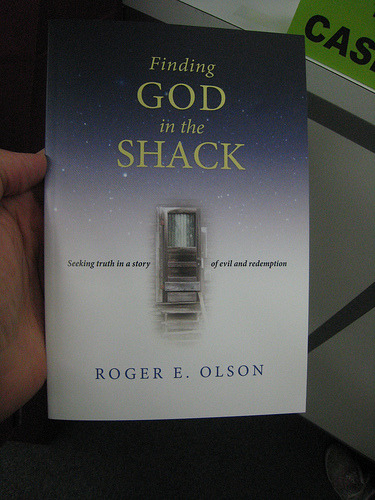
Biblical call plan, anyone?
Friday, September 11th, 2009 Just found a note of a funny exchange I had with my mobile phone company a few years back…
Me: Can you please just put me back on the basic off-peak call plan?
Vodafone: “Ah, so you’d be wanting to go on to Gethsemane then?”
Me: “Sorry?!”
Vodafone: “You’re wanting to go on to Gethsemane then?”
Me: “Gethsemane?”
Vodafone: “No – Get 70 – the Get 70 call plan!”
Me: “Ah…yes, please.”
Seek not to understand
Thursday, September 10th, 2009Seek not to understand that you may believe, but believe that you may understand.
St. Augustine